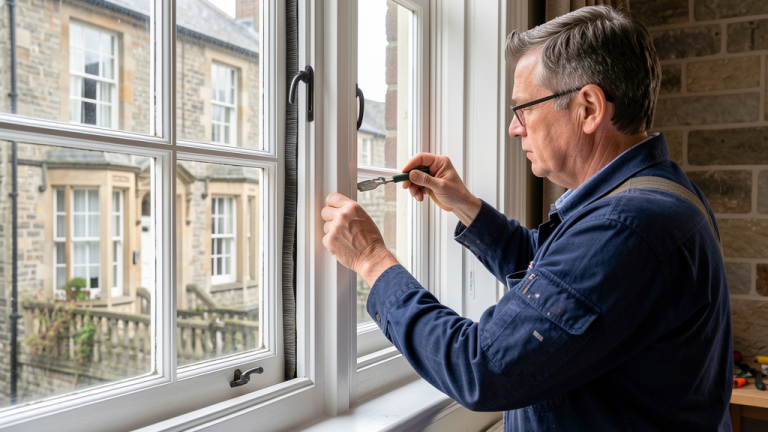
DIY Sash Window Repairs: What You Can and Cannot Do in Edinburgh
DIY Sash Window Repairs in Edinburgh: What You Can and Cannot Do
Many Edinburgh homeowners are tempted to repair their own sash windows. A broken cord, a stuck sash, or a loose pane of glass can seem like a straightforward job — and for some tasks, it is. But the reality is that sash windows are precision-balanced mechanisms. The sashes, which weigh 10–20kg depending on size and timber thickness, are counterbalanced by cast iron weights hidden inside the frame pockets. Getting the repair wrong can turn a £60 cord replacement into a £400 full restoration.
This guide separates DIY-safe tasks from jobs that require a professional sash window specialist. It is based on data from Edinburgh window repair specialists, the UK Woodworking Federation, and Historic Environment Scotland guidelines. If you are unsure about your skill level, the safest course is to call a professional.
Table 1: DIY Sash Window Repairs — Skill Levels and Feasibility
| Repair Task | Skill Level Required | DIY Risk | Time Required | Tools Needed (£ Cost) | DIY Safe? |
|---|---|---|---|---|---|
| Cutting paint seals on stuck sashes | Beginner | Very low | 10–20 min per window | Stanley knife, paint scraper (£10) | ✅ Yes |
| Cleaning sash channels | Beginner | Very low | 15–30 min per window | Vacuum, thin blade, brush (£0–£20) | ✅ Yes |
| Replacing putty on single pane | Intermediate | Low | 30–60 min per pane + 2-week cure | Linseed oil putty, putty knife, primer (£15–£30) | ✅ Yes (with practice) |
| Sash cord replacement (one cord) | Intermediate | Moderate | 1–2 hours per cord | Screwdriver, new cord, sash weight, knots (£10–£20) | ⚠️ Possible with good guidance |
| Freeing a sash with swollen timber | Intermediate | Moderate | 30–60 min | Plane or sandpaper, dehumidifier (£15–£100) | ⚠️ Risk of over-sanding |
| Bottom rail timber splice | Advanced | High | 2–4 hours per window | Chisel, router, epoxy, clamps, matching timber (£30–£60) | ❌ Not recommended |
| Pulley replacement | Advanced | High | 1–3 hours per pulley | Spanner, replacement pulley, frame access (£15–£40) | ❌ Not recommended |
| Full sash removal and rebalancing | Specialist | Very high | 3–5 hours per window | Full toolset, sash weight knowledge (£50+) | ❌ Not recommended |
Safety Warning: Sash Weights Can Cause Serious Injury
Before attempting any sash window repair that involves opening the weight pocket, understand this: each sash is counterbalanced by two cast iron weights, typically 5–10kg each. Together, the weights for one sash total 10–20kg. If you open the pocket without securing the sash, the weights will fall. A falling 10kg cast iron weight can:
- Break floorboards or tiles on impact
- Cause serious foot or leg injury
- Damage the internal frame structure
- Pull through the pulley system, damaging the frame
Always secure the sash before opening any weight pocket. Use a wooden wedge or clamp to hold the sash in position. If you cannot securely brace the sash, do not proceed — call a professional.
DIY-Safe Task 1: Cutting Paint Seals on Stuck Sashes
The most common reason Edinburgh sash windows will not open is not a structural fault — it is layers of paint that have bonded the sash to the frame. In a city where sash windows have been painted every 5–10 years for over a century, paint build-up of 2–5mm is common, creating an effective adhesive seal around the entire sash perimeter.
How to do it:
- Run a sharp Stanley knife along the meeting rail — the horizontal joint where the upper and lower sashes meet
- Cut along both sides of the staff bead (the vertical strip holding the lower sash in place)
- Gently tap the sash from the inside with a rubber mallet or the heel of your hand
- Once the sash starts moving, work it up and down a few millimetres to break remaining paint bridges
- Vacuum the channels to remove paint debris
Cost: £10 for a new Stanley knife. A professional would charge £40–£60 for the same task. Tool cost recouped on the first window.
DIY-Safe Task 2: Replacing Window Putty
Old putty that has cracked, shrunk, or fallen away from the glass is a common issue in Edinburgh’s sash windows. Replacing it is one of the few DIY jobs that is genuinely straightforward and low-risk.
Materials needed:
- Linseed oil putty (available at any Edinburgh builders’ merchant — Jewson Edinburgh, Travis Perkins Leith)
- Putty knife (approximately £8–£15)
- Wood primer
- White spirit for cleanup
Process:
- Remove all loose and cracked putty using a putty knife or old chisel
- Prime the bare wood rebate where the glass sits — this prevents the new putty from drying too quickly
- Knead the putty into a rope shape and press firmly into the rebate, ensuring full contact with both the glass and the wood
- Trim at a 45-degree angle using the putty knife
- Leave to cure for a minimum of 2 weeks before painting — longer in Edinburgh’s damp climate
Cost: £15–£30 for materials, covering 4–6 window panes. Professional cost: £25–£80 per pane.
DIY-Safe Task 3: Cleaning Sash Channels
Dirt, dust, dead insects, and old paint fragments accumulate in the sash channels over decades. This debris can prevent the sash from sliding freely even when there is no structural defect.
How to do it:
- Vacuum the full length of both channels (left and right of the sash) using a narrow nozzle attachment
- Run a thin flexible blade along the full depth of the channel to dislodge compacted debris
- Vacuum again
- Lightly lubricate with silicone spray — never use oil, which attracts dust and will gum up within months
DIY of Caution: Sash Cord Replacement
Sash cord replacement is the most common DIY-adjacent repair, and it is where most mistakes happen. The task itself is mechanically simple — remove the staff bead, extract the old cord, tie a new cord, reattach the weight, and reassemble. However, the consequences of getting it wrong are significant:
Common DIY mistakes:
- Wrong cord type: Using nylon cord instead of braided polyester. Nylon stretches, degrades in UV light, and fails within 10–20 years. Braided polyester lasts 50–80 years with a 200kg breaking strain.
- Wrong knot: A poorly tied cord-to-weight knot can slip, causing the weight to detach and the sash to drop without warning.
- Wrong weight: Reattaching to the wrong weight (or mis-matching the weight to the sash) causes the sash to either slam shut or refuse to stay open.
- Damage to staff bead: Old painted-on staff beads often splinter when removed. A single replacement bead costs £20–£50; a full set of replacement beads costs £100+.
- Missing the opportunity: If one cord has failed, the other three are close behind. Replacing only one cord guarantees another failure within 1–3 years.
Recommendation: If you are confident in your woodworking and knot-tying skills, cord replacement is possible. But a professional can replace all four cords, rebalance the weights, and test the window in under 2 hours for £60–£120. The marginal cost of professional vs DIY is often less than the cost of fixing a mistake.
Table 2: DIY vs Professional — Cost Comparison for Common Repairs
| Repair Task | DIY Tool Cost | DIY Time (Hours) | DIY Success Rate (Est.) | Professional Cost | Cost of Fixing a DIY Mistake |
|---|---|---|---|---|---|
| Cutting paint seals (10 windows) | £10 | 2–3 | ~95% | £400–£600 | £0 (no damage possible) |
| Putty replacement (4 panes) | £20 | 2–3 + curing | ~80% | £100–£320 | £25–£50 (redo one pane) |
| Sash cord (1 window) | £15 | 1–3 | ~60% | £60–£120 | £80–£200 (broken bead, wrong knot) |
| Freeing stuck sash | £10 | 0.5–1 | ~70% | £40–£100 | £80–£150 (if frame is damaged) |
| Bottom rail splice | £50 | 3–5 | ~30% | £80–£200 | £150–£400 (full replacement needed) |
| Full sash removal + overhaul | £80 | 6–10 | ~20% | £150–£400 | £200–£600 (sash weight damage) |
Source: DIY success rates estimated from Edinburgh sash window specialist surveys (2023–2025). Professional costs from industry rate data.
Conservation Area Restrictions on DIY Work
If your property is in an Edinburgh conservation area — including the New Town World Heritage Site, Stockbridge, Marchmont, Morningside, Bruntsfield, Leith, or the Old Town — there are legal restrictions on what work you can do without consent.
Key rules for DIY:
- Like-for-like repair is generally permitted (e.g., replacing a cord, re-puttying a pane, cutting paint seals)
- Changing window style, profile, or material requires planning permission — including replacing a single sash that does not match the original profile
- If you remove a staff bead and break it, the replacement must match the original profile exactly — non-matching beads are a common enforcement issue
- Removing original crown glass and replacing with modern float glass is technically a material alteration and may require consent in listed buildings
- For Category A or B listed buildings, even internal repairs that affect the fabric of the window may require Listed Building Consent
Historic Environment Scotland’s guidance states: “The aim must be to achieve the best practicable energy performance without harming the building’s special interest.” DIY work that damages original fabric is directly contrary to this principle.
Table 3: Recommended Tools for DIY Sash Window Repairs
| Tool | Approximate Cost | Essential For | Available In Edinburgh |
|---|---|---|---|
| Stanley knife / craft knife | £5–£10 | Cutting paint seals, trimming putty | B&Q Edinburgh, Robert Dyas, Screwfix |
| Putty knife (1 inch) | £8–£15 | Putty application and shaping | Jewson Edinburgh, Travis Perkins Leith |
| Screwdriver set (flathead + Pozidriv) | £10–£25 | Removing beads, accessing pockets | Toolstation, Screwfix, B&Q |
| Linseed oil putty | £8–£15 per tub | Glazing repairs | Jewson, Brewers Decorator Centres |
| Braided polyester sash cord | £5–£10 per metre | Cord replacement (200kg breaking strain) | Specialist timber merchants, online |
| Silicone spray lubricant | £6–£12 | Lubricating sash channels | Halfords Edinburgh, B&Q |
| Rubber mallet | £10–£20 | Tapping stuck sashes free | Screwfix, Toolstation |
| Moisture meter | £20–£40 | Checking timber for rot before repair | Screwfix, Amazon |
Edinburgh Climate Considerations for DIY Repairs
Edinburgh’s climate — with average annual rainfall of 685mm, high humidity, and temperature swings from -5°C to 25°C — affects sash window repairs in ways that are not always obvious to the DIYer.
- Putty curing: In Edinburgh’s damp conditions, linseed oil putty takes a minimum of 2 weeks to cure before painting. Attempting to paint earlier traps moisture and causes the putty to fail within 1–2 years. In winter, allow 3–4 weeks.
- Paint drying: Microporous paints (recommended for Edinburgh’s climate) require minimum drying temperatures of 8°C. Painting in cold or wet weather causes blistering and peeling.
- Timber swelling: Edinburgh’s humidity causes timber to swell in autumn and winter. A sash that fits perfectly in July may not close in November. If you plane a sash in summer to make it fit, it may be loose and draughty by winter.
- Rot risk: The combination of rain, humidity, and north-facing exposures means timber rot develops faster in Edinburgh than in drier UK cities. A small area of rot that is ignored for one Edinburgh winter can spread 100–200mm.
When You Must Call a Professional
You should call a sash window specialist immediately if:
- The sash has dropped and cannot be safely operated — the weights may be loose inside the frame
- Timber rot extends more than 50mm into the bottom rail — this requires professional splicing
- You have attempted a repair and made the problem worse
- Your property is a listed building and the work requires Listed Building Consent
- Multiple windows are affected — professional bulk pricing is more cost-effective than individual DIY attempts
- Pre-1965 paint is present — it likely contains lead, requiring specialist handling
- The staff beads are painted on and you are not confident you can remove them without splintering
Conclusion: Know Your Limits
DIY sash window repair in Edinburgh is possible for a narrow range of tasks. Cutting paint seals, replacing putty, and cleaning channels are genuinely safe and cost-effective DIY jobs. Cord replacement is possible with good guidance but carries moderate risk. Timber splicing, pulley replacement, and full sash removal should always be left to professionals.
The cost of a professional repair — £60 for a cord, £80 for a timber splice, £40 for freeing a stuck sash — is typically less than the cost of fixing a botched DIY attempt. And for conservation area and listed building properties, unauthorised DIY work that damages original fabric can lead to enforcement action.
We provide sash window repair services throughout Edinburgh, including the New Town, Old Town, Stockbridge, Leith, Marchmont, Morningside, Bruntsfield, the Grange, Portobello, Inverleith, Murrayfield, Corstorphine, and all surrounding areas.
For professional advice or a free quotation, call 0131 381 8222 to speak with our Edinburgh team.